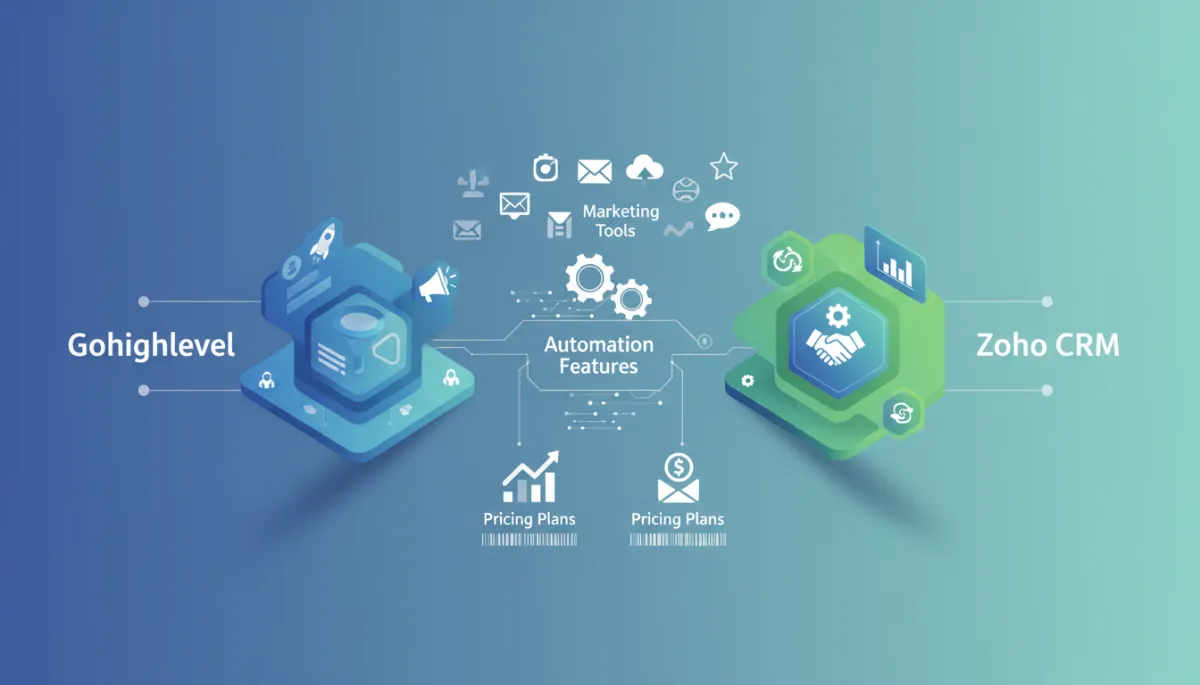
GoHighLevel vs Zoho CRM: Features & Pricing
CRM Comparison, GoHighLevel, Zoho CRM, Automation Features, Pricing Plans, Marketing Tools
GoHighLevel vs Zoho CRM: Features, Pricing & Automation for Agencies and Growing Businesses
Choosing the right CRM can be the difference between a scattered tech stack and a streamlined revenue engine. In this CRM comparison, we’ll break down GoHighLevel vs Zoho CRM with a focus on features, pricing plans, automation capabilities, and built‑in marketing tools—so agencies and growing businesses can decide which platform fits their model best.
Executive Diagnostic: Which CRM Fits Your Business Model?
Before you compare line‑item features or pricing tiers, step back and look at how your business actually generates revenue. Use this quick diagnostic as a filter before you dive deeper into GoHighLevel vs Zoho CRM.
Do you primarily generate leads through marketing campaigns or outbound sales outreach?
Do you need funnels, landing pages, and forms built directly into your CRM, or will you keep those in separate tools?
Will you manage multiple client accounts from one platform (as an agency or white‑label provider)?
Do you require white‑label capabilities so clients see your brand instead of the CRM vendor’s?
Is your team more focused on marketing automation and lead nurture or on sales process management and forecasting?
How important is implementation speed versus deep customization and integration with other business systems?
📌 Key Takeaway: Businesses focused on lead generation and marketing automation often lean toward GoHighLevel, while organizations prioritizing structured sales processes and broader business operations frequently prefer Zoho CRM.
Quick Comparison Summary
If you only remember one thing from this comparison, make it this: GoHighLevel is typically the better choice for agencies, consultants, coaches, and service businesses that want CRM, funnels, email marketing, SMS, and automation in a single platform. Zoho CRM is often the stronger option for organizations focused on sales process management, reporting, and integration with a broader suite of business applications. The right choice depends less on the raw feature list and more on whether your business is marketing‑driven or sales‑driven.
GoHighLevel vs Zoho CRM at a Glance
Dimension GoHighLevel Zoho CRM Core Focus All‑in‑one marketing, funnels, and client account management Traditional CRM, sales process, and analytics at the center of a suite Features Model Bundled funnels, email, SMS, booking, reputation tools Modular add‑ons for marketing, service, and other apps Pricing Model Flat account‑based plans with unlimited users; usage fees for comms Per‑user tiers; lower entry cost for small internal sales teams AI Capabilities Conversation & voice AI for lead capture, follow‑up, and booking Zia for lead scoring, forecasting, content suggestions, and analytics White‑Label Options Extensive white‑label and SaaS mode for agencies (desktop & mobile) Limited; more focused on internal use than resale Ideal Business Type Marketing agencies, local service businesses, coaches, consultants B2B sales teams, professional services, multi‑department organizations
GoHighLevel vs Zoho CRM: Who They’re Built For
While both platforms are powerful, GoHighLevel and Zoho CRM were designed with slightly different primary audiences in mind—understanding this is the first step in choosing wisely.
GoHighLevel (Gohighlevel): Built first and foremost for marketing agencies, coaches, and service businesses that want an all‑in‑one system—CRM, funnels, email, SMS, reputation management, booking, and advanced automation in one place. It’s especially attractive if you resell marketing systems to clients under your own brand.
Zoho CRM: A more traditional CRM at the center of a broad business suite. It shines for sales‑driven organizations that want strong pipeline management, deep reporting, and tight integration with finance, support, and marketing tools across the Zoho ecosystem.
📌 Key Takeaway: Choose GoHighLevel if you sell and automate marketing services; choose Zoho CRM if you’re building a scalable, process‑driven sales organization with broader business app needs.
Features & Marketing Tools: All‑in‑One vs Modular Stack
When comparing features, the biggest difference is how each platform approaches marketing tools and CRM capabilities.
GoHighLevel Features & Built‑In Marketing Tools
Unified CRM & Pipelines: Manage leads, opportunities, and clients in customizable pipelines tailored to each niche you serve.
Funnels & Websites: Drag‑and‑drop funnel and landing page builder included—no need for a separate tool like ClickFunnels or Webflow for most use cases.
Native Email & SMS Marketing: Broadcasts, campaigns, and two‑way SMS are built in, plus ringless voicemail, call tracking, and power dialer options (usage fees apply for messages and calls according to 2026 pricing data from gohighlevel.ai).
Reputation & Booking: Review requests, Google My Business messaging, and calendar booking are part of the core feature set—ideal for local businesses and agencies managing them.
Zoho CRM Features & Ecosystem Strength
Robust Core CRM: Lead, contact, account, and deal management with advanced views, territory management (Enterprise+), and strong reporting. Independent reviews in 2026 rate Zoho CRM around 4.3/5 for feature depth and value for money (SmartProcessFlow, TechRadar).
AI‑Powered Productivity: Zia suggests next actions, scores leads, predicts deal closure, and even generates formulas and content using natural language, with reported lead‑scoring accuracy close to 78% in some tests (crmcompared.com).
Modular Marketing Tools: For full marketing automation you’ll typically pair Zoho CRM with Zoho Campaigns or Zoho Marketing Automation, plus integrations to WhatsApp and other channels. This offers flexibility but adds configuration overhead compared to Gohighlevel’s bundled approach.
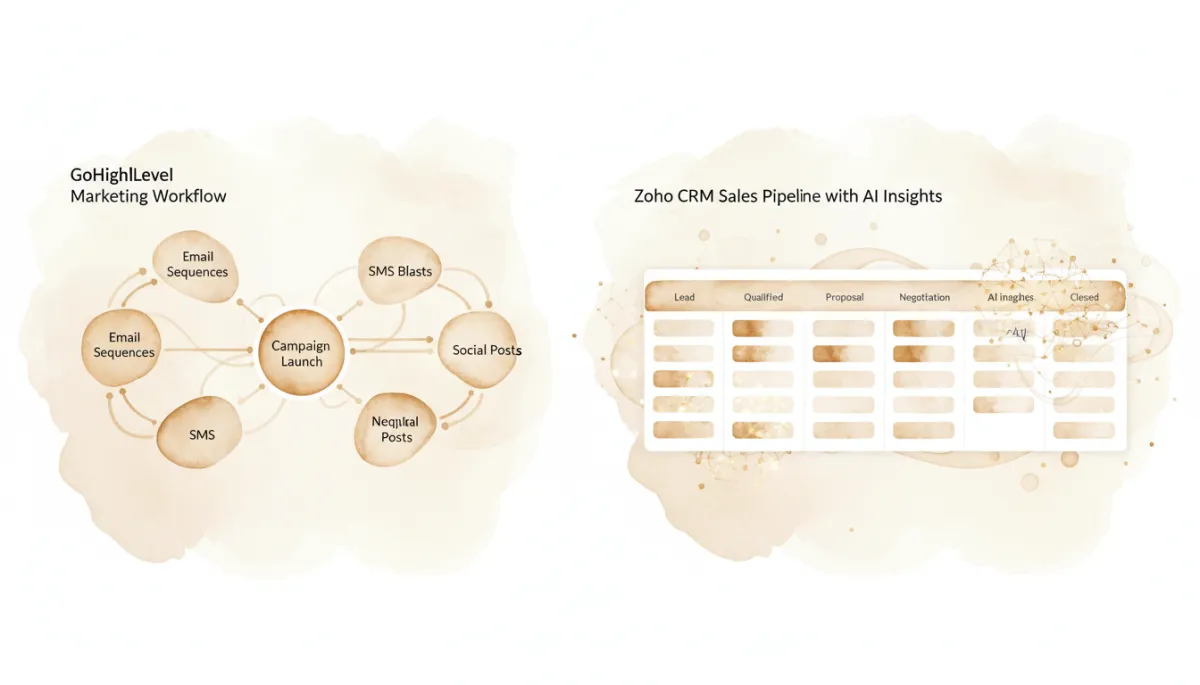
GoHighLevel leans marketing-first, while Zoho CRM emphasizes structured sales and analytics.
Real‑World Scenario Comparison
Agency Example: 20‑Client Marketing Firm
A boutique marketing agency manages campaigns for 20 local businesses. They need:
CRM to track leads and opportunities for each client
Funnels and landing pages for lead capture across niches
SMS and email automation for follow‑up and reactivation campaigns
Appointment booking for each client’s sales team or calendar
White‑label reporting and the ability to resell the platform as their own “system”
Winner: GoHighLevel. Its multi‑account structure, snapshots, and white‑label SaaS mode make it much easier to roll out standardized funnels and automations across many clients without stitching together multiple tools.
Professional Services Example: Consulting Firm
A consulting firm sells high‑ticket retainers to mid‑market companies. They need:
Detailed pipeline management across long, multi‑stage sales cycles
Robust reporting and forecasting for partners and finance leaders
Internal sales processes with approvals, hand‑offs, and compliance checks
Integration with finance tools and project management for post‑sale delivery
Winner: Zoho CRM. Its Blueprint engine, territory management, and tight integration with the broader Zoho suite (including finance and support) align better with complex, process‑driven sales environments.
Pricing Plans: Flat Platform vs Per‑User Licensing
Pricing is where GoHighLevel vs Zoho CRM diverge sharply. One follows a flat, account‑based model geared to agencies; the other uses per‑user tiers typical of enterprise CRMs.
GoHighLevel Pricing (2026)
Starter – $97/month: Full platform for a single agency account with up to three sub‑accounts, unlimited users and contacts, core CRM, marketing tools, and automation. Best for solopreneurs or small teams (gohighlevel.ai, 2026 pricing).
Unlimited – $297/month: Everything in Starter plus unlimited sub‑accounts, API access, white‑label desktop, and advanced deployment tools like snapshots—ideal for agencies with multiple clients.
SaaS Pro – $497/month: Adds SaaS mode, white‑label mobile app, rebilling with markup, and priority support, letting agencies resell the platform as their own SaaS product.
Annual billing trims roughly 17% off each plan, but remember to factor in usage‑based costs such as SMS, calls, email volume, and AI tools. Many agencies see real monthly costs end up 30–50% above the base subscription once usage is included (netpartners.marketing, 2026).
Zoho CRM Pricing (2026)
Free: Up to three users with basic CRM features—good for very small teams testing the waters.
Standard & Professional (≈$14–$23/user/month, billed annually): Add better automation, scoring, and inventory features—solid for small sales teams.
Enterprise & Ultimate (≈$40–$52/user/month): Unlock advanced AI (Zia), Blueprint, sandbox environments, and enhanced analytics, aimed at larger or more complex organizations (zoho.com, 2026 edition comparison).
For agencies, Zoho’s per‑user pricing can add up quickly as you grow your team, but for a single in‑house sales team, the total cost can be lower than stacking multiple third‑party tools on top of Gohighlevel.
Automation Features: Marketing Journeys vs Sales Governance
Automation is where this CRM comparison becomes especially important for agencies and scaling businesses. Both platforms invest heavily here, but with different philosophies.
GoHighLevel Automation Features
Visual Workflows: Drag‑and‑drop workflows that trigger on form fills, pipeline changes, missed calls, bookings, and more. Actions span SMS, email, voicemail, tasks, and pipeline moves—perfect for multi‑channel nurture sequences.
Conversation & Voice AI: AI chat and SMS bots reply in seconds, while voice AI agents answer calls, capture lead data, and even book appointments (gohighlevel.ai, 2026 updates).
Agency‑Friendly Scaling: Snapshots let you clone full automation systems into new client sub‑accounts in minutes, making GoHighLevel extremely attractive for agencies selling packaged marketing operations.
Zoho CRM Automation Features
Blueprint & Workflow Rules: Automate stage transitions, enforce approvals, and ensure reps follow defined steps—ideal for regulated or complex B2B sales processes (consultevo.com, 2026 comparison).
Zia & Pathfinder: Zia Agent Studio can autonomously qualify leads and schedule follow‑ups, while Pathfinder maps optimal customer journeys and recommends when automation versus human touch works best.
Workqueue & Smart Assistant: A centralized Workqueue surfaces every important task across modules, and AI‑powered prompts help reps draft personalized emails or notes directly inside records (zoho.com, Q1 2026 update).
💡 Pro Tip: If your primary goal is automated lead capture, nurture, and booking across SMS and email, GoHighLevel’s marketing‑first automation will feel more natural. If you need strict sales governance and predictive analytics, Zoho CRM’s automation stack is hard to beat.
Contrarian Insight: Most Businesses Choose CRM Based on Features Instead of Workflows
Many buyers compare CRM platforms by counting features, add‑ons, and integrations. In reality, the best CRM is usually the one that matches how your team already works. Businesses often overestimate the value of additional functionality while underestimating the importance of adoption. A simpler platform that aligns with your daily operations frequently produces better revenue outcomes than a more feature‑rich platform that requires significant customization, training, and change management.
Which CRM Is Right for Your Business or Agency?
In the GoHighLevel vs Zoho CRM debate, there is no universal winner—only a better fit for your model and growth plans:
Choose GoHighLevel if you are an agency or service business wanting a single platform for CRM, funnels, SMS, email, and advanced automation, with the ability to package and resell these systems to clients under your own brand.
Choose Zoho CRM if you are building a scalable, process‑driven sales organization that values strong governance, deep AI‑powered insights, and tight integration with finance, support, and other business apps.
For many agencies, starting with GoHighLevel’s Starter or Unlimited plan delivers the fastest time‑to‑value. For in‑house sales teams, especially in B2B or multi‑department environments, Zoho CRM’s Enterprise or Ultimate editions can provide a more strategic long‑term foundation. Whichever route you choose, prioritize clear processes, clean data, and thoughtful automation design—your CRM will only be as powerful as the strategy behind it.
Future Outlook: CRM Platforms Become Unified Revenue Systems
Over the next several years, CRM platforms will continue merging marketing, sales, customer service, artificial intelligence, and business intelligence into unified revenue operating systems. The distinction between CRM, marketing automation, and customer engagement software will keep blurring as vendors compete to own the entire customer lifecycle—from first click to renewal and expansion.
GoHighLevel is already pushing aggressively into AI‑driven conversations and white‑label SaaS, while Zoho CRM is deepening its analytics, automation, and ecosystem integrations. Businesses evaluating platforms today should consider not only current features, but also which ecosystem can support their growth over the next five to ten years—especially around AI, reporting, and cross‑department collaboration.
GoHighLevel vs Zoho CRM: FAQ
Is GoHighLevel cheaper than Zoho CRM?
For agencies managing multiple clients, GoHighLevel often becomes more cost‑effective because it includes unlimited users, sub‑accounts (on higher tiers), and bundled marketing tools. For smaller internal sales teams with only a few reps, Zoho CRM’s per‑user pricing can offer a lower entry cost—especially if you don’t need advanced marketing automation on day one.
Can GoHighLevel replace Zoho CRM?
For marketing‑focused businesses and agencies, yes—GoHighLevel can often replace both a traditional CRM and several separate marketing tools. However, for organizations heavily invested in the broader Zoho ecosystem (finance, support, analytics, custom apps), replacing Zoho CRM with GoHighLevel may require additional planning, integrations, or compromises around reporting and governance.
Which CRM has better automation?
It depends on your definition of “better.” GoHighLevel excels at marketing automation, lead nurturing, and multi‑channel communication across SMS, email, and voice. Zoho CRM is stronger in structured sales workflows, approvals, and process governance, with Zia adding predictive insights and recommendations. Match the automation style to your dominant revenue engine.
Which CRM is easier to implement?
GoHighLevel generally offers a faster implementation timeline for agencies and service businesses because funnels, forms, calendars, and messaging are already bundled and pre‑integrated. Zoho CRM can take longer to configure, especially if you are designing complex Blueprints, custom modules, and integrations with other Zoho or third‑party apps—but that extra setup can pay off in highly governed, scalable processes.
Can I use GoHighLevel and Zoho CRM together?
Some organizations use GoHighLevel for front‑end marketing and lead capture while keeping Zoho CRM as the system of record for sales. This hybrid approach can work well if you have the technical resources to maintain integrations and clear rules about which system owns which part of the customer journey.


