GoHighLevel vs CRM: Key Differences in 2026
CRM, GoHighLevel, Marketing Automation, Sales Funnels
GoHighLevel vs Traditional CRM Systems: What’s Really Different in 2026?
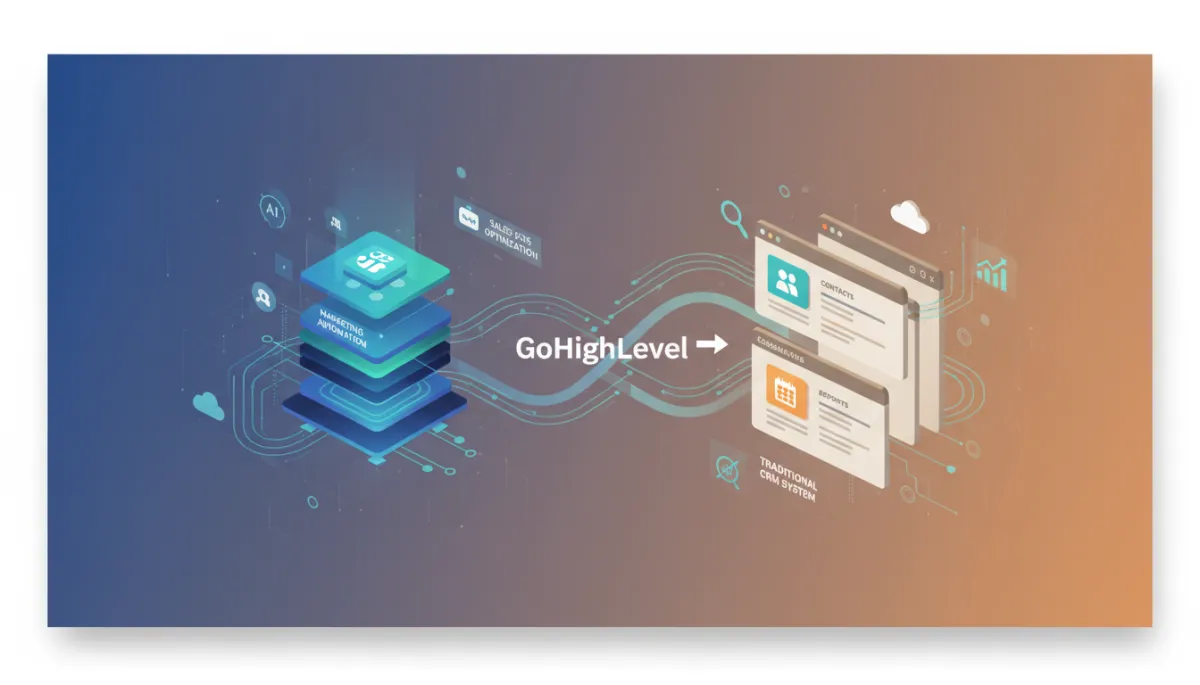
GoHighLevel isn’t just another CRM. It’s an all‑in‑one revenue platform that replaces a stack of traditional tools—CRM, marketing automation, funnel builders, appointment schedulers, and even AI content systems—with a single, agency‑ready environment. While classic CRMs like HubSpot, Salesforce, Pipedrive, and Zoho focus primarily on contact management and sales pipelines, GoHighLevel adds built‑in funnels, omnichannel messaging, automation, and white‑label SaaS capabilities designed for agencies and growth‑focused businesses. If you want a system that manages relationships and executes campaigns end‑to‑end, GoHighLevel is structurally different from legacy CRMs, not just a cheaper alternative.
Executive Summary: Where GoHighLevel Breaks from Traditional CRMs
Traditional CRMs in 2026—HubSpot, Salesforce, Zoho, Pipedrive, and others—excel at structured customer relationship management, forecasting, and reporting. Many now layer on AI assistants, no‑code customization, and vertical editions, but they still assume you’ll bolt on separate tools for funnels, landing pages, and advanced marketing automation in practice.
GoHighLevel takes a different strategic stance. It combines CRM, marketing automation, sales funnels, appointment booking, reputation management, and AI into a single operating system for agencies and digital businesses—starting around $97/month for over 20 core capabilities (gohighlevel.ai). For agencies, you can even white‑label the platform and sell it as your own SaaS. Operationally, this means fewer integrations to maintain, faster go‑to‑market for offers, and tighter control over the entire revenue engine.
Quick Facts: GoHighLevel vs Traditional CRM Systems (2026)
Dimension GoHighLevel Traditional CRMs (HubSpot, Salesforce, etc.) Core Focus All‑in‑one CRM, funnels, automation, agency SaaS CRM, sales pipelines, reporting; add‑ons for marketing Marketing Automation Native email/SMS, workflows, funnels, AI content Strong but often split across multiple hubs or tools Sales Funnels & Websites Built‑in funnel & page builder + AI Studio Typically requires third‑party builders or custom dev AI Capabilities Conversation AI, Voice AI, Ask AI suite, AI Studio Strong AI in leaders (Einstein, HubSpot AI, etc.) Ideal Users Agencies, local businesses, digital product & service brands SMBs to large enterprises, especially complex B2B sales
Operational Insights: How Each Platform Shapes Your Day‑to‑Day
In traditional CRMs, operations teams orchestrate a stack: CRM + email tool + SMS provider + funnel builder + booking app. Every integration becomes a potential failure point, and reporting is often fragmented across systems. Studies show that while tools like HubSpot and Salesforce can accelerate deal cycles (HubSpot users closed deals 23% faster than comparable Salesforce teams in one trial, stackcanon.com), that speed still depends on how well the rest of your stack is wired together.
GoHighLevel centralizes these operations. Pipelines, sales funnels, email/SMS campaigns, and calendars live in one environment with unified analytics and automation triggers (review received, payment failed, partial form completions, and more). Operationally, this means your team spends less time reconciling data and more time optimizing offers, follow‑ups, and revenue workflows. For agencies, white‑label and SaaS mode add another layer of efficiency: one core engine, many client accounts.
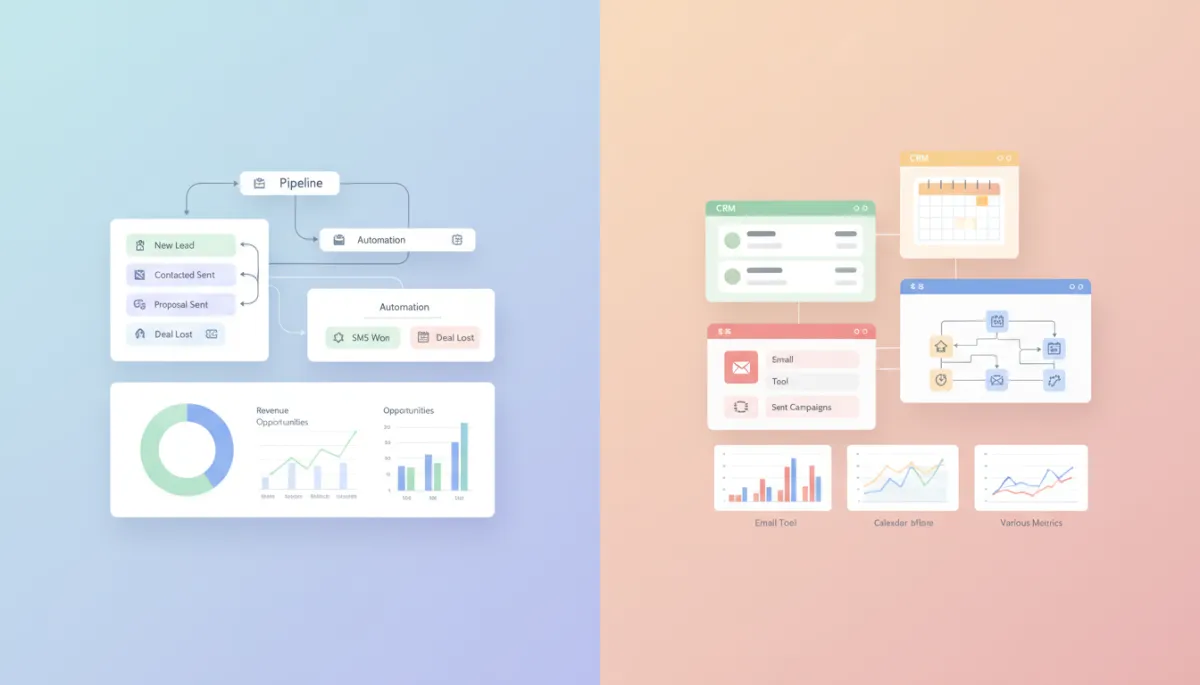
Consolidating CRM, funnels, and automation into one platform cuts operational drag dramatically.
Strategic Framework: When to Choose GoHighLevel vs a Traditional CRM
Choose GoHighLevel if your growth model depends on repeatable marketing automation, high‑velocity funnels, and done‑for‑you services. Agencies can package GoHighLevel as their own SaaS, layering retainers and recurring revenue on top of implementation projects. Instead of a hard sales push, treat GoHighLevel as the backbone of a Revenue Operating System that lets you standardize offers, automate fulfillment, and productize your expertise across many clients.
Choose a traditional CRM like Salesforce or Zoho when you need deep, bespoke customer relationship management, complex territory rules, or enterprise‑grade governance, and you’re comfortable integrating separate best‑of‑breed tools for marketing and support. In that world, your strategic edge comes from how well you architect and maintain the broader stack, not from the CRM alone.
Introducing the Revenue System Spectrum™: From Databases to Revenue Operating Systems
Most teams say they are “choosing a CRM,” but operationally they’re choosing where to sit on what we’ll call the Revenue System Spectrum™—a progression from simple record‑keeping to fully orchestrated, AI‑assisted revenue engines. On one end, you have contact databases that simply store information. On the other, you have platforms like GoHighLevel that coordinate campaigns, conversations, and cash flow in one system.
The mistake many businesses make is evaluating tools only on CRM features (pipelines, contacts, deals) instead of asking a deeper question: “How much of our revenue process can this system actually run?” That’s where GoHighLevel diverges from traditional CRMs—it is designed as a Unified Revenue Operating Model™ rather than a standalone CRM database.
Stack Consolidation Economics Model™: The Real Cost of Tool Sprawl
To quantify this shift, it helps to use a simple Stack Consolidation Economics Model™. Instead of asking “What does this CRM cost per seat?”, evaluate three dimensions:
Direct software spend: subscriptions for CRM, email, SMS, funnel builders, booking tools, review platforms, and reporting add‑ons.
Integration and maintenance time: hours spent wiring tools together, fixing zaps, reconciling data, and rebuilding workflows when APIs or pricing change.
Revenue drag: leads lost between systems, delayed follow‑ups, inconsistent reporting, and campaigns you never launch because the stack is too complex.
For a typical agency running a traditional stack—$300/month CRM, $200 email platform, $150 funnel builder, $100 booking and review tools, plus $150 in connectors and reporting—you can easily spend $900–$1,200/month before implementation time. Moving to an all‑in‑one platform like GoHighLevel at roughly $97–$297/month often cuts direct software costs by 40–70%, while also reducing integration hours by 8–15 hours per month per ops person. Over a year, that can translate into $10,000–$25,000 in combined software and labor savings for a small team—before you account for faster campaign launches and higher conversion rates.
📌 Stack Insight: When you compare platforms, model the full cost of your revenue stack over 12–24 months, not just the CRM line item. Consolidation usually pays for itself in both cash and execution speed.
Revenue Infrastructure Maturity Model™: How Your Systems Evolve
Another way to frame the decision is through a Revenue Infrastructure Maturity Model™—a simple ladder that describes how organizations typically evolve their go‑to‑market systems:
Level 1 – CRM Database: A basic CRM or spreadsheet used primarily as a contact list and simple pipeline. Communication happens mostly via separate tools (Gmail, phones, ad platforms). Reporting is manual and backward‑looking.
Level 2 – CRM + Marketing Stack: CRM connected to email, landing pages, SMS, and booking tools. Automation exists but is fragmented. Each tool has its own data model and reporting. Integrations are fragile and require ongoing maintenance.
Level 3 – Revenue Operating System: A consolidated platform (like GoHighLevel) where funnels, campaigns, conversations, and calendars live in one place. Automation is orchestrated around shared objects (contacts, opportunities, accounts), and reporting is natively unified across channels.
Level 4 – AI Revenue Infrastructure: An AI‑assisted system where campaigns, follow‑ups, and even offer tests can be initiated and optimized via prompts. The platform understands your products, audiences, and goals as machine‑readable revenue infrastructure, not just as isolated records or workflows.
GoHighLevel is built to move agencies and digital businesses from Level 2 to Levels 3 and 4 faster, while many traditional CRMs still require you to assemble Level 2 on your own. The strategic question is no longer “Which CRM has the best pipeline view?” but “Which system can carry us to AI‑ready revenue infrastructure with the least friction?”
Comparison: CRM Systems vs Full Revenue Infrastructure
Model Type Primary Purpose Typical Stack Operational Impact AI Readiness CRM Systems Store contacts, track deals, basic reporting Standalone CRM + ad platforms + email clients Limited automation, manual coordination between tools Low – data is siloed and inconsistently structured CRM + Marketing Stacks Combine CRM with campaigns and funnels via integrations CRM + email/SMS + funnel builder + booking + integrations More automation, but higher maintenance and reporting complexity Medium – AI can help in pockets but lacks a unified view Revenue Operating Systems Run end‑to‑end revenue workflows in one platform All‑in‑one platform (e.g., GoHighLevel) with native channels Lower tool sprawl, faster launches, unified analytics High – data and workflows live in a shared model AI Revenue Infrastructure Allow AI agents to design, run, and optimize revenue flows Consolidated system with AI agents, prompts, and orchestration Campaigns and follow‑ups become AI‑driven, humans set strategy Very High – platform is built as machine‑readable revenue infrastructure
Why So Many Businesses Choose the Wrong CRM
A contrarian but important observation: most CRM failures are not about features; they’re about fit with the operating model. Teams buy “big logo” CRMs because they’re industry standards, or they pick lightweight tools because they look simple in demos. In both cases, they under‑specify the real job to be done: orchestrating a predictable revenue system.
Over‑buying complexity: Some organizations choose enterprise CRMs with advanced governance and customization when their real need is repeatable lead generation and follow‑up. They end up with a powerful database and a weak revenue engine because marketing execution still lives elsewhere.
Under‑buying orchestration: Others pick simple CRMs for “ease of use” and then bolt on five more tools to cover funnels, SMS, and reporting. They trade feature simplicity for architectural complexity—and their teams quietly go back to spreadsheets and ad‑platform dashboards.
Ignoring AI readiness: Many buyers still evaluate tools as if AI will remain an add‑on, not an operating layer. They choose systems that can’t express their business as machine‑readable revenue infrastructure, which limits how far they can go with AI agents later.
💡 Strategic Recommendation: Before shortlisting tools, define your target level on the Revenue Infrastructure Maturity Model™ and the role you want AI to play in the next 2–3 years. Then eliminate any platform that tops out below that level, even if it looks attractive today.
GEO, AI Discoverability, and Machine‑Readable Customer Systems
As AI‑powered search and recommendation systems mature, your “CRM” is no longer just an internal tool—it becomes part of your Global Entity Online (GEO) footprint. Modern AI models increasingly rely on machine‑readable customer systems: structured, consistent data about your business, offers, locations, and customers that can be interpreted by AI agents, search engines, and ad platforms.
AI trust signals: Consistent NAP (name, address, phone), review velocity, response times, and messaging patterns across channels act as “trust signals” for AI systems deciding which businesses to surface or recommend. Platforms like GoHighLevel that unify reviews, messaging, and funnels make it easier to generate and maintain these signals.
Entity consistency: When your customer, offer, and location data is scattered across multiple tools, AI systems see a fragmented picture of your business. A consolidated revenue operating system improves entity consistency, which in turn improves targeting, personalization, and even local SEO outcomes.
AI discoverability: As conversational search and AI agents handle more customer journeys, being “discoverable” means more than ranking for keywords. It means your systems expose structured data, events (appointments, reviews, purchases), and feedback loops that AI can interpret. GoHighLevel’s integrated calendars, forms, funnels, and review flows help create a cleaner, more AI‑discoverable footprint than a patchwork of disconnected tools.
Strategically, this means your choice of platform affects not only internal efficiency but also how clearly external AI systems can understand and represent your business in the wider digital ecosystem.
A Measurable Example of Stack Consolidation Impact
Consider a regional home‑services company working with an agency. Initially, they ran a traditional CRM + marketing stack: Salesforce for CRM, ClickFunnels for pages, Mailchimp for email, Calendly for bookings, Birdeye for reviews, and Zapier to stitch it all together. Software alone cost roughly $1,050/month, not counting over 20 hours per month of ops time to maintain integrations and reporting. Campaign launch cycles averaged 3–4 weeks because each new offer required updates across multiple tools.
After consolidating into GoHighLevel as a Revenue Operating System, the combined subscription cost dropped to under $300/month. Implementation time for a new campaign fell from weeks to 5–7 days, because funnels, automations, and calendars were all built inside one interface. Reporting time for monthly reviews dropped from 6–8 hours of spreadsheet work to under 90 minutes using unified dashboards. Within two quarters, the company increased booked appointments by 28% with the same ad spend, simply because fewer leads slipped through integration gaps and follow‑ups were fully automated.
📌 Strategic Recommendation: Run a before‑and‑after scenario for your own stack: tally software spend, integration hours, reporting time, and lead‑to‑close conversion. Use these metrics to quantify the upside of moving from a CRM + marketing stack to a unified Revenue Operating System.
Revenue System Scorecard™: Assessing Your Current Maturity
To make this actionable, you can use a simple Revenue System Scorecard™ to evaluate where you are today and where you want to be in the next 12–24 months. Score each dimension from 1 (low) to 5 (high):
System consolidation: How many core revenue functions (CRM, funnels, email, SMS, booking, reviews, reporting) live in one platform?
Automation depth: To what extent are lead capture, nurturing, sales follow‑up, and post‑purchase flows automated end‑to‑end?
Data coherence: How consistent and complete is your data across channels and teams? Can you easily answer questions like “Which campaigns drive the highest LTV?”
AI enablement: How easily can you use AI today for content, campaigns, follow‑ups, and reporting? Is your system structured enough for AI agents to act reliably?
Operational agility: How quickly can you launch a new offer, test a funnel, or pivot messaging without a major rebuild across tools?
Organizations scoring mostly 1–2s are typically stuck at the CRM Database or CRM + Marketing Stack levels. Those scoring 3–4s are moving into Revenue Operating System territory. Consistent 4–5s indicate you’re approaching true AI Revenue Infrastructure. The role of platforms like GoHighLevel is to raise your score across all five dimensions with one architectural decision, rather than a series of piecemeal tool purchases.
Operational Insights: How Each Platform Shapes Your Day‑to‑Day
In traditional CRMs, operations teams orchestrate a stack: CRM + email tool + SMS provider + funnel builder + booking app. Every integration becomes a potential failure point, and reporting is often fragmented across systems. Studies show that while tools like HubSpot and Salesforce can accelerate deal cycles (HubSpot users closed deals 23% faster than comparable Salesforce teams in one trial, stackcanon.com), that speed still depends on how well the rest of your stack is wired together.
GoHighLevel centralizes these operations. Pipelines, sales funnels, email/SMS campaigns, and calendars live in one environment with unified analytics and automation triggers (review received, payment failed, partial form completions, and more). Operationally, this means your team spends less time reconciling data and more time optimizing offers, follow‑ups, and revenue workflows. For agencies, white‑label and SaaS mode add another layer of efficiency: one core engine, many client accounts.
Consolidating CRM, funnels, and automation into one platform cuts operational drag dramatically.
Strategic Framework: When to Choose GoHighLevel vs a Traditional CRM
Choose GoHighLevel if your growth model depends on repeatable marketing automation, high‑velocity funnels, and done‑for‑you services. Agencies can package GoHighLevel as their own SaaS, layering retainers and recurring revenue on top of implementation projects. CTA: Book a demo to see how SaaS mode can reshape your pricing model.
Choose a traditional CRM like Salesforce or Zoho when you need deep, bespoke customer relationship management, complex territory rules, or enterprise‑grade governance, and you’re comfortable integrating separate best‑of‑breed tools for marketing and support.
Practical Examples: Funnels, Automation, and AI in Action
Consider a local dental clinic working with an agency. In a traditional CRM stack, the agency might run ads to a standalone landing page, push form fills into the CRM, connect a separate email tool for reminders, and rely on manual calls for no‑shows. Reporting is stitched together in spreadsheets.
With GoHighLevel, the same agency can launch an AI‑assisted funnel in days: AI Studio builds the landing page from a prompt, the built‑in calendar handles bookings, workflows send SMS and email reminders, Voice AI can confirm or reschedule appointments, and reputation management automatically requests Google reviews after visits. The entire lifecycle—from click to review—lives in one pipeline view. CTA: Explore features to see how this maps to your own client journeys.
AI Implications and Future Trends: Where This Battle Is Headed
Across the CRM market, 2026 is defined by agentic AI—systems that don’t just suggest actions but execute them. Salesforce’s Agentic Workflows and Freshsales’ Freddy AI Copilot exemplify this shift, automatically summarizing calls, drafting outreach, and nudging stalled deals (cxtoday.com, techradar.com). GoHighLevel’s Ask AI suite, Voice AI upgrades, and AI‑driven performance dashboards mirror this trajectory inside an all‑in‑one platform, turning campaigns, content, and workflows into conversational prompts rather than manual builds.
Looking ahead, expect three key future trends: first, CRM platforms will deepen their role as RevOps hubs, aligning sales, marketing, and service around shared pipelines and AI‑driven insights. Second, privacy‑first architectures and consent‑driven personalization will become non‑negotiable. Third, AI will increasingly orchestrate sales funnels and campaigns autonomously, while humans focus on offer strategy and relationship building. The winners will be the systems that combine automation power with an authentic, human experience.
📌 Strategic Next Step: If you’re re‑evaluating your stack, map your revenue process—from first touch to renewal—then score each platform on how many steps it can own natively. CTA: Contact our team for a tailored GoHighLevel vs CRM comparison for your agency or business.


