GoHighLevel vs Salesforce: CRM Comparison Guide
CRM Software, Marketing Automation, Business Management Tools
GoHighLevel vs Salesforce: Complete Comparison for Agencies and Businesses
Choosing between GoHighLevel and Salesforce can reshape how you manage leads, clients, and revenue. Here’s a focused Salesforce comparison for teams that care about speed, automation, and ROI.

GoHighLevel vs Salesforce
Choosing the right CRM and marketing automation stack
CRM Software and Core Philosophy
GoHighLevel is an all‑in‑one platform built primarily for agencies and service businesses. It combines Customer Relationship Management, funnels, forms, two‑way messaging, and appointment scheduling in a single login, with flat pricing and unlimited users (sources: gohighlevel.ai, consultevo.com). This makes it attractive if you resell services or need repeatable client workspaces.
Salesforce is the enterprise benchmark for CRM software, known for deep customization, complex data models, and governance. It excels when you need tight integrations with ERP, CPQ, or industry‑specific systems and can invest in admins or consultants to manage it (sources: smartprocessflow.com, consultevo.com).
Marketing Automation and Business Management Tools
GoHighLevel bakes marketing automation directly into its CRM: visual workflows, email and SMS campaigns, AI‑powered conversations, pipelines, calendars, and reporting all live in one place. For agencies, white‑labeling and client sub‑accounts turn it into a true business management tool.
Salesforce offers world‑class automation through flows, Process Builder, and add‑ons like Marketing Cloud, but these often require extra licenses and longer implementations. The result is powerful Customer Relationship Management, yet with higher total cost of ownership.
Executive Diagnostic: Which CRM Environment Do You Need?
Before comparing features, ask yourself:
Do you need a CRM administrator?
Do you require white-label capabilities?
How many integrations do you currently use?
Is speed of deployment important?
Will multiple teams require different permissions and workflows?
The answers often determine the right platform faster than feature comparisons alone.
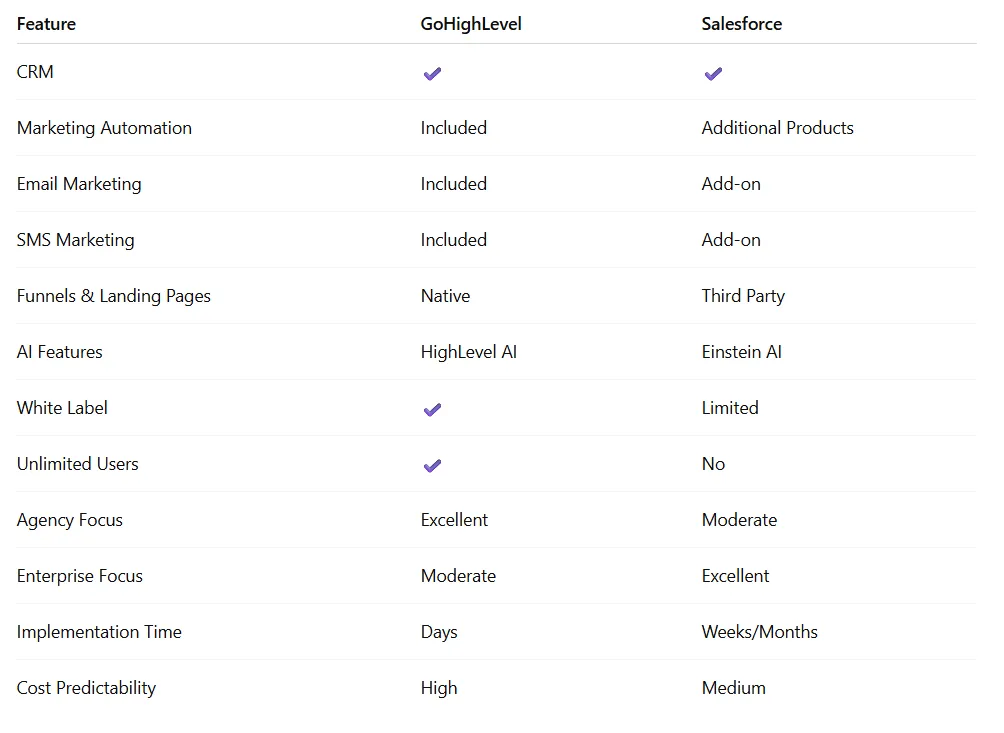
Agencies often favor GoHighLevel’s all-in-one model, while enterprises lean toward Salesforce’s modular stack.
AI Features Comparison
Artificial intelligence is becoming a major factor in CRM selection.
GoHighLevel focuses on practical AI features such as conversational AI, automated follow-up, appointment booking assistance, and AI-powered workflows designed for agencies and service businesses.
Salesforce Einstein offers advanced predictive analytics, forecasting, lead scoring, and enterprise-grade AI insights. While extremely powerful, it often requires larger datasets and more technical implementation.
For most SMBs, GoHighLevel AI provides faster time-to-value, while Salesforce Einstein delivers greater analytical depth for larger organizations.
Total Cost of Ownership
Many businesses underestimate the true cost of CRM implementation.
While GoHighLevel operates on a relatively predictable subscription model, Salesforce often requires additional investments in implementation, administration, customization, training, and third-party integrations.
For SMBs focused on speed and efficiency, total ownership cost frequently becomes a deciding factor.
Real-World Decision Framework
Choose GoHighLevel if:
You run an agency.
You sell services.
You need funnels and automation.
You want white-label capabilities.
You need fast implementation.
Choose Salesforce if:
You manage enterprise operations.
You require deep customization.
You need advanced reporting.
You have internal CRM resources.
You require complex integrations.
Real-World Scenarios: Agency vs. Enterprise
To make the decision more concrete, consider these simplified scenarios:
Agency Example
A 15-client marketing agency needs:
Centralized CRM to track all client accounts
Funnel building for each client’s campaigns
Built-in SMS and email for follow-up
White-label portals so clients see the agency’s brand
Automation to handle lead nurturing and appointment booking
Winner: GoHighLevel — it delivers all of this in one subscription with client sub-accounts and white-labeling.
Enterprise Example
A manufacturing company requires:
Deep ERP integrations for inventory, orders, and billing
Strict compliance controls and audit trails across regions
Multi-department workflows spanning sales, service, and operations
Winner: Salesforce — its ecosystem, governance features, and integration depth are better suited to complex enterprise environments.
Contrarian Insight: Most Businesses Don't Need Enterprise CRM Complexity
Many organizations assume the most powerful CRM is automatically the best choice. In reality, most small and medium businesses never fully utilize enterprise-level capabilities. The challenge is rarely a lack of features—it is adoption, implementation, and execution. A platform that your team actively uses every day often produces better revenue outcomes than a more sophisticated system that requires consultants, administrators, and months of configuration. For many growth-focused businesses, simplicity and speed create a greater competitive advantage than complexity.
Future Outlook: CRMs Become Revenue Operating Systems
Over the next several years, CRM platforms will evolve beyond contact management. Artificial intelligence, automation, customer data, marketing campaigns, and sales workflows will become increasingly interconnected. The winning platforms will not simply store customer information—they will actively recommend actions, automate engagement, forecast revenue, and orchestrate customer journeys across every channel.
Businesses evaluating CRM platforms today should consider not only current functionality but also how well each ecosystem aligns with their future growth strategy.
FAQs
Is GoHighLevel a Salesforce competitor?
For SMBs and agencies, yes. For large enterprises requiring deep customization and complex integrations, Salesforce remains stronger.
Can GoHighLevel replace Salesforce?
For many agencies and service businesses, GoHighLevel can fully replace Salesforce by combining CRM, funnels, and automation. For enterprise organizations with heavy compliance requirements and legacy infrastructure, it may not cover every edge case.
Which CRM is cheaper long-term?
GoHighLevel generally offers a lower total ownership cost because it bundles marketing automation, funnels, and communications into one subscription and is faster to implement.
Which CRM has better AI?
Salesforce Einstein is more advanced analytically, especially for large datasets and complex forecasting. GoHighLevel AI focuses on practical lead generation, follow-up, and automation that most agencies can deploy quickly.
Which Platform Fits Your Growth Plan?
If you’re an agency or growing service business needing fast deployment, bundled marketing automation, and predictable pricing, GoHighLevel is often the better strategic fit. If you’re a larger organization prioritizing complex workflows, compliance, and a vast app ecosystem, a well‑planned Salesforce implementation may deliver more long‑term flexibility—at a premium.


