GoHighLevel vs HubSpot: Best CRM for 2026
CRM, GoHighLevel vs HubSpot, Marketing Automation
GoHighLevel vs HubSpot: Which CRM Makes More Operational Sense in 2026?
GoHighLevel is an all‑in‑one, agency‑focused CRM and marketing automation platform with flat‑rate pricing and white-label SaaS options. HubSpot is an enterprise‑grade customer relationship management ecosystem with deep reporting, integrations, and AI‑driven revenue operations.
Executive Summary: Who Should Choose What?
If you run a marketing agency or service business that lives and dies by sales funnels, lead generation, SMS marketing, appointment booking, and white label SaaS, GoHighLevel (GHL) is usually the operationally smarter bet. Flat pricing, built‑in funnels, AI automation, reputation management, and multi‑client sub‑accounts let you run a repeatable “client delivery operating system” instead of stitching tools together (source stack example).
HubSpot shines when you need enterprise‑level CRM depth, advanced pipeline management, revenue operations, and Answer Engine Optimization across complex teams. You pay more, but gain refined analytics, integrations, and AI‑assisted RevOps.
Aspect GoHighLevel HubSpot Core Focus Agency CRM, funnels, marketing automation Enterprise CRM, RevOps, analytics Key Benefits Flat pricing, SMS/email, funnels, white label SaaS Deep CRM, AI AEO, advanced reporting Typical Use Cases Local lead gen, appointment funnels, resellable SaaS B2B pipelines, multi‑team RevOps, complex reporting Pricing Model Flat plans from $97/mo, unlimited contacts Free CRM, but per‑seat/per‑contact escalates quickly Complexity Medium; optimized for repeatable client snapshots Medium–High; powerful but heavier to configure Best‑Fit Audience Agencies, local businesses, consultants Mid‑market and enterprise in‑house teams
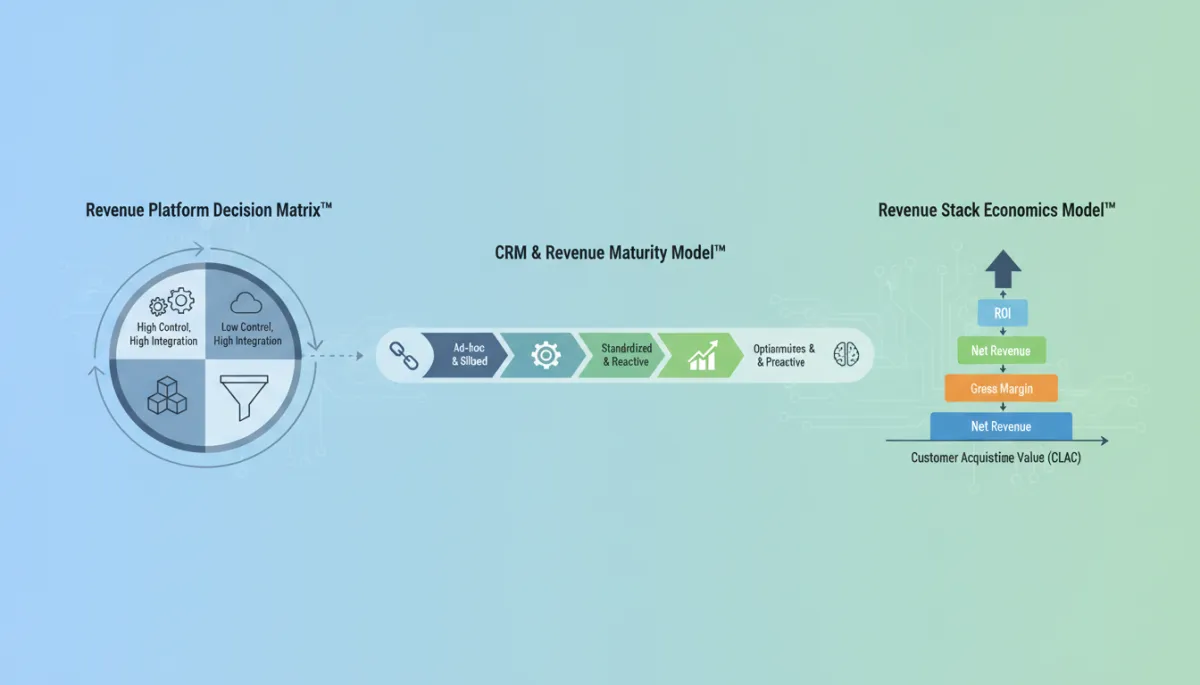
Revenue Platform Decision Matrix™
To move beyond opinions, use a Revenue Platform Decision Matrix™ that scores each platform across operationally critical dimensions. Weight each criterion based on your strategy, then compare total scores.
Criterion Weight (%) GoHighLevel Score (1–10) HubSpot Score (1–10) Multi‑client management & sub‑accounts 20 9 5 Funnel‑first marketing automation 15 9 7 Enterprise RevOps & attribution depth 20 6 9 AI‑assisted content, AEO & prospecting 15 7 9 Total cost of ownership at scale 15 9 6 Implementation speed & snapshot reuse 15 9 7
Agencies weighting multi‑client delivery and cost efficiency will often see GoHighLevel win this matrix, while B2B organizations prioritizing RevOps and AEO will see HubSpot score higher.
CRM & Revenue Maturity Model™
Your CRM & Revenue Maturity Model™ should guide platform choice more than any feature checklist. Map where you are today and where you plan to be in 18–36 months.
Level 1 – Capture & Respond: Leads come from a few channels, follow‑up is manual, and reporting is mostly “feel.” GoHighLevel gives you funnels, pipelines, and automation in one place to move into predictable capture and nurture.
Level 2 – Programmed Acquisition: You run repeatable offers, standardized onboarding, and templates for campaigns. GoHighLevel snapshots and white label SaaS mode let agencies and local operators clone proven systems across accounts.
Level 3 – Integrated RevOps: Multiple teams (marketing, sales, CS) share one view of the customer, with lifecycle stages, SLAs, and revenue attribution. HubSpot’s Smart CRM and multi‑hub architecture shine here.
Level 4 – AI‑Orchestrated Revenue: You design machine‑readable playbooks, AI‑assisted prospecting, and AEO‑optimized content across markets. HubSpot’s AEO and agents plus GoHighLevel’s AI tasking can coexist in a hybrid stack, but require strong operational design.
The key is not to over‑buy for your level. A Level‑1 local business on a Level‑4 RevOps platform will drown in unused configuration.
Revenue Stack Economics Model™
A Revenue Stack Economics Model™ compares unified platforms like GoHighLevel or HubSpot to fragmented tool stacks (separate funnel builder, email, SMS, booking, reviews, CRM). The goal is to understand fully loaded cost per revenue dollar.
Unified platform (e.g., GoHighLevel): Flat subscription, lower integration overhead, fewer vendors, and standardized workflows. Margins improve as you add clients or locations because implementation is repeatable.
Unified enterprise platform (e.g., HubSpot multi‑hub): Higher software line item, but lower data loss, better attribution, and higher revenue per rep in complex B2B environments.
Fragmented stack: Lower entry cost, but hidden expenses in integration maintenance, data discrepancies, and team training. Over 18–24 months, these soft costs usually exceed the perceived savings.
📌 Key Takeaway: When you calculate cost per booked appointment or cost per qualified opportunity—including labor and integration time—unified platforms almost always outperform patchwork stacks.
Operational Insights, Frameworks & Real‑World Examples
A practical way to decide is to map your revenue system maturity:
Stage 1 – Capture & Nurture: Need landing pages, sales funnels, email marketing, SMS marketing, appointment booking, and basic pipeline management? A GoHighLevel snapshot from GetSetGHL Snapshots can launch a done‑for‑you operating system in days, not months.
Stage 2 – Scale & Productize: Agencies turn GoHighLevel into white label SaaS, charging recurring retainers while GHL handles CRM, AI automation, and business automation under the hood.
Stage 3 – Enterprise RevOps: When you need multi‑touch attribution, complex buyer committees, and AI‑driven Answer Engine Optimization, HubSpot’s Smart CRM, AEO, and Prospecting Agent become compelling.
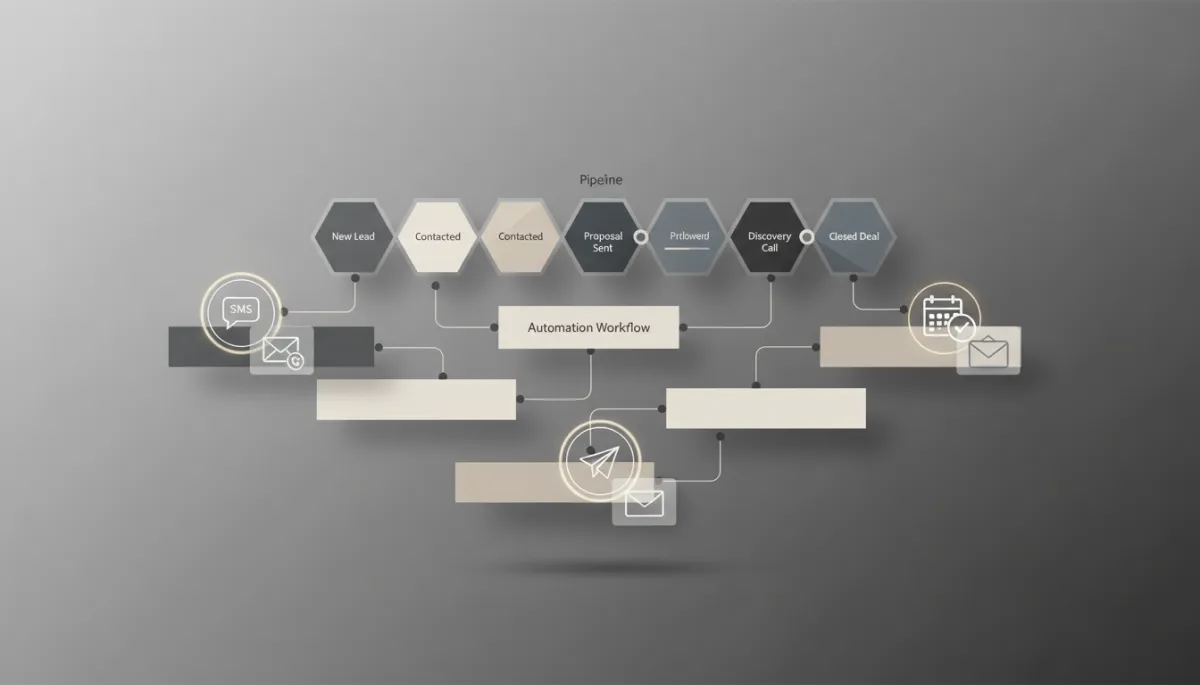
Agencies often standardize one GoHighLevel snapshot as their client delivery system.
Contrarian View: Operational Architecture Beats Feature Lists
Most CRM debates obsess over features—AI widgets, email templates, pipeline views. In practice, the winners are the teams that invest in operational architecture: how leads move, how data is structured, and how humans and automations interact.
A poorly designed funnel and pipeline in HubSpot will underperform a well‑architected GoHighLevel snapshot every time, even if HubSpot has more knobs to turn.
A disciplined sales process, clear SLAs, and clean data schemas can turn a “simple” GoHighLevel setup into a compounding asset that beats over‑engineered enterprise stacks.
Conversely, when your buyer journeys span multiple regions, products, and personas, trying to force everything into a basic tool creates operational drag that no amount of hustle can fix.
⚠️ Warning: If you cannot sketch your lead flow, routing logic, and follow‑up rules on a whiteboard in under 10 minutes, no CRM—GoHighLevel or HubSpot—will save you from chaos.
Common Mistakes & Best Practices
Mistake: Choosing HubSpot for simple local lead generation when GoHighLevel would cover CRM, marketing automation, reputation management, and conversion optimization at a fraction of the cost.
Mistake: Using either platform as “just email marketing software” instead of building a full revenue operations system around it.
Best Practice: Start from an implementation framework: define one primary pipeline, one lead generation offer, one nurture sequence, and one clear handoff from marketing automation to sales.
💡 Pro Tip: Use a pre‑built operating system like the Local Visibility Operating System to standardize campaigns, then deploy it via GoHighLevel for each client.
GEO, AI Discoverability & Machine‑Readable Revenue Systems
As AI‑driven discovery expands across regions and languages, your CRM choice should support entity consistency, machine‑readable data, and AI trust signals across all the markets you serve.
Entity consistency across GEOs: Whether you serve a single U.S. metro or operate in multiple countries, you need consistent business names, categories, and location data flowing from your CRM into listings, landing pages, and review profiles. GoHighLevel’s local SEO and reputation tools help standardize this for multi‑location operators, while HubSpot’s CRM properties and integrations support global B2B entities.
Machine‑readable systems: AI systems increasingly rely on structured data—schema markup, consistent UTM conventions, standardized lifecycle stages. HubSpot’s AEO and content tools lean heavily on this structure; GoHighLevel can generate and pass this data through templated funnels and automations at scale.
AI trust signals for local and regional markets: High‑volume, well‑tagged reviews, consistent NAP data, and clear service boundaries (cities, regions, verticals) signal reliability to AI ranking systems. GoHighLevel’s built‑in review management and HubSpot’s customer feedback tools can both feed these signals—if your operational design enforces consistency.
The more markets you serve, the more valuable a CRM becomes as the source of truth for entities, offers, and locations that downstream AI systems will interpret.
Revenue Models & AI‑Driven Future Trends
GoHighLevel’s SaaS Pro tier lets agencies build recurring revenue by reselling CRM, SMS marketing, and AI automation as a branded platform, while HubSpot’s model centers on per‑seat and per‑hub revenue across Sales, Marketing, and Service teams. Both are rapidly layering AI: GHL with “Ask AI” tasks and review management; HubSpot with AEO, Breeze Assistant, and Customer Agent.
In an AI‑first world, your real advantage is operational design: clear processes for lead capture, pipeline management, and follow‑up that tools can automate reliably.
Vendor Scorecard: Matching Platforms to Organization Types
Use this vendor scorecard to align GoHighLevel and HubSpot with your organizational profile. Scores are directional (1 = weak fit, 10 = ideal fit) and assume a well‑implemented system.
Organization Type Primary Need GoHighLevel Fit (1–10) HubSpot Fit (1–10) Marketing agencies Multi‑client acquisition & delivery 9–10 6–7 Local service businesses (single‑location) Lead gen, bookings, reviews 8–9 5–6 Multi‑location & franchise networks Standardized local campaigns & reporting 8–9 7–8 Mid‑market B2B firms Account‑based selling & RevOps 6–7 8–9 Enterprise organizations (multi‑region) Complex, global RevOps & governance 4–6 (often as a front‑end layer) 9–10
Case Study: Agency Revenue Lift with GoHighLevel Snapshot
A regional marketing agency serving home‑services businesses migrated from a fragmented stack (ClickFunnels, Mailchimp, Calendly, separate review tool, and spreadsheets) to a standardized GoHighLevel snapshot across 32 client accounts.
Implementation: 45 days to design a master snapshot (funnels, automations, pipelines, review flows), then 2–3 hours per client to deploy and localize.
Operational impact (first 6 months): Average response time to new leads dropped from 3 hours to under 10 minutes thanks to SMS and workflow automation. Show‑up rates for booked appointments increased by 18% with reminder sequences.
Financial impact: Client churn decreased from 27% annually to 14%, and the agency added a white label SaaS fee of $197/month per account. Net new recurring revenue from the SaaS line alone exceeded $75,000/year, with no additional full‑time hires.
The key driver was not a single feature, but the combination of standardized operational design and a platform optimized for multi‑client delivery.
Expert Recommendations & Final Verdict
Choose GoHighLevel if your priority is client acquisition and delivery for multiple businesses, and you want one platform for CRM, sales funnels, email, SMS, appointment booking, and reputation management.
Choose HubSpot if you’re building a long‑horizon, multi‑team RevOps engine with complex reporting and Answer Engine Optimization at the center of your growth strategy.
Many agencies run a hybrid model: GoHighLevel as the client‑facing marketing automation and white label SaaS layer, HubSpot as the internal system of record for enterprise accounts.
Conclusion: Match Platform to Organizational Maturity
The most important question is not “Is GoHighLevel better than HubSpot?” but rather “Which platform matches our current and future maturity?”
If you are still standardizing offers, funnels, and follow‑up—and especially if you serve many small businesses—GoHighLevel aligns with your operating reality and economics.
If you already have defined lifecycle stages, clear handoffs between marketing, sales, and success, and you’re pushing into multi‑region or multi‑product RevOps, HubSpot becomes an enabling layer rather than overkill.
Choose the platform that reinforces the behaviors and processes you need next—not the one with the most logos on its integrations page. As your organization matures, you can evolve toward a hybrid architecture where each tool plays to its strengths inside a coherent revenue system.
FAQs: GoHighLevel vs HubSpot for Agencies & Growth Teams
1. Is GoHighLevel a full CRM or just marketing automation?
It is a full CRM plus marketing automation, pipelines, appointment booking, and sales funnels in one platform.
2. When does HubSpot make more sense than GoHighLevel?
When you need advanced revenue operations, multi‑hub analytics, and enterprise‑grade integrations across departments.
3. Which is better for agencies running multiple clients?
GoHighLevel, thanks to sub‑accounts, flat pricing, and white label SaaS mode designed for agencies.
4. How do pricing models differ in real life?
GHL stays mostly flat as you add contacts; HubSpot costs scale with seats, hubs, and contact volume.
5. Can I white label HubSpot like GoHighLevel?
No. HubSpot has partner programs, but you cannot fully white label the platform as your own SaaS.
6. Which platform handles SMS marketing better?
GoHighLevel, because SMS and voice workflows are native, not bolt‑ons, and tie directly into funnels.
7. Is HubSpot stronger for B2B account‑based sales?
Yes. Its Smart CRM, buyer intent signals, and multi‑touch attribution are built for complex B2B pipelines.
8. How do GoHighLevel snapshots help with implementation?
Snapshots from GetSetGHL clone funnels, automations, and CRM settings into new accounts instantly.
9. Which is easier for non‑technical business owners to start with?
With a good snapshot and onboarding, GoHighLevel is typically faster to operationalize for local lead generation.
10. How do AI features compare between GoHighLevel and HubSpot?
GHL focuses on AI for tasks, conversations, and review management; HubSpot emphasizes AI for AEO, content, prospecting, and customer support.
11. Can I integrate GoHighLevel with HubSpot?
Yes, via native and third‑party connectors, letting GHL handle front‑end funnels while HubSpot remains the system of record.
12. What are typical revenue models on GoHighLevel for agencies?
Retainers plus SaaS subscriptions, where clients pay monthly for access to a white‑label CRM and automation suite.
13. How do I avoid over‑complicating my CRM setup?
Start with one core offer, one funnel, one pipeline, and add complexity only after data proves the need.
14. Where can I see real‑world GoHighLevel configurations?
Browse implementation breakdowns on the GetSetGHL blog and then book a demo.
15. Where do I sign up for GoHighLevel?
You can start a trial via the official link: GoHighLevel sign‑up.
📌 Implementation CTA: To see how a mature GoHighLevel setup can work for your agency, you can Book a Demo, Explore Features, or View Snapshots and then Contact Our Team for implementation support.


