GoHighLevel: CRM, Marketing & Sales Unified
GoHighLevel, CRM Platform, Marketing Automation, Sales Integration, Lead Generation, Business Management
How GoHighLevel Combines CRM, Marketing and Sales in One Platform
GoHighLevel (HighLevel) has evolved into a single operating system for agencies and service businesses—uniting CRM, marketing automation, sales pipelines, reputation, and AI employees in one neutral, professional platform. Used strategically, it replaces a patchwork of tools and turns your client journey into a measurable, repeatable revenue engine.
Executive Summary: What GoHighLevel Is and Why It Matters
At its core, GoHighLevel is an all-in-one CRM platform that combines contact management, pipelines, funnels, email and SMS marketing, calendars, reviews, memberships, and AI automation. For agencies, it adds white-label, SaaS mode, and snapshots, allowing you to resell the platform and standardize delivery across clients (gohighlevel.ai).
What makes this powerful is not just the feature list, but that HighLevel organizes everything into a HighLevel Revenue Operating System™ (HROS™)—a way of running your business where data, workflows, and decisions are connected end to end. Throughout this article, HROS™ is the lens: features matter only insofar as they support a coherent revenue operating system.
Quick Fact Detail (2026) Core Focus Unified CRM, marketing automation, and sales integration within the HighLevel Revenue Operating System™ (HROS™) Pricing $97–$497/month plus usage for SMS, email, AI (gohighlevel.ai) Standout Frameworks HighLevel Revenue Operating System™ (HROS™), GoHighLevel Economics Model™, Revenue Automation Flywheel™, HighLevel Maturity Model™ Standout Feature White-label SaaS mode for agencies and AI-first revenue operations AI Capabilities AI Employees, Ask AI, Voice AI, Workflow AI, AI funnels
The HighLevel Revenue Operating System™: Layers and Outcomes
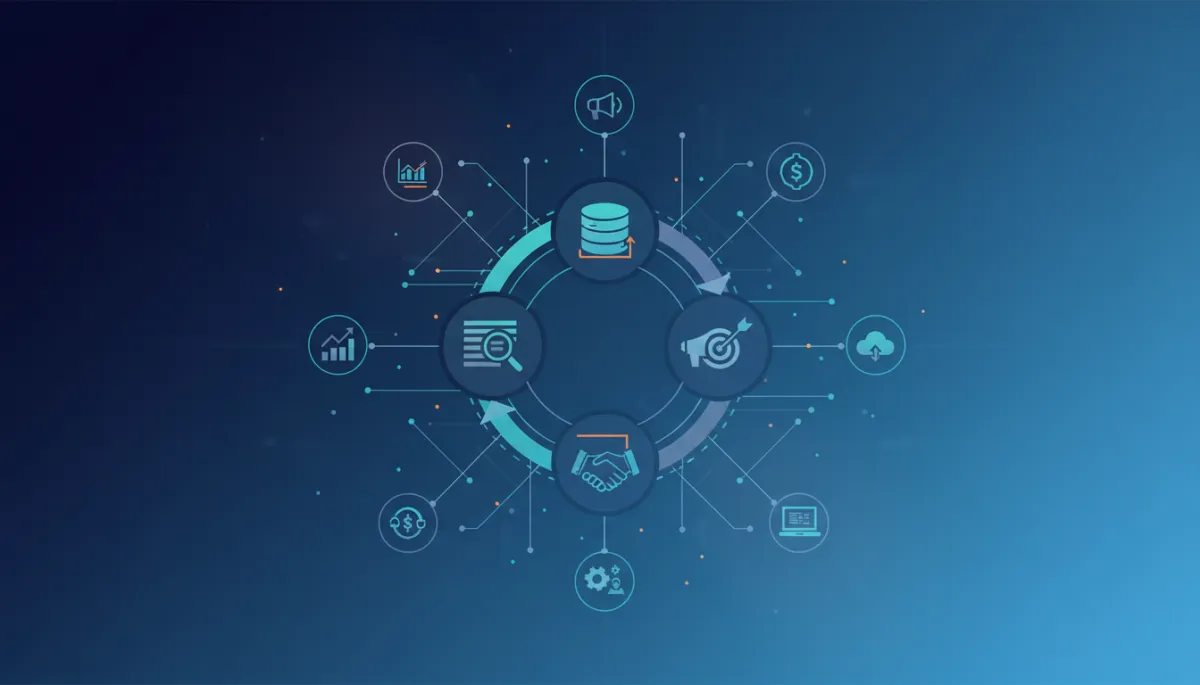
The HighLevel Revenue Operating System™ (HROS™) is a mental model for running GoHighLevel as your business backbone. Instead of “a bunch of features,” think in operational layers that work together to produce predictable revenue and intelligence.
Data Layer (CRM & Identity): Contacts, accounts, opportunities, and activities live in one database with consistent fields, tags, and custom values. Outcome: a single source of truth for every lead and customer interaction.
Engagement Layer (Funnels & Messaging): Websites, funnels, forms, surveys, email, SMS, DMs, and Voice AI all plug into that CRM. Outcome: every touchpoint is captured and attributable to a campaign and stage.
Automation Layer (Workflows & AI): Visual workflows, triggers, and AI Employees orchestrate follow-up, tasking, and routing. Outcome: fewer manual handoffs, faster speed-to-lead, and consistent experiences at scale.
Revenue Layer (Pipelines & Payments): Opportunities, quotes, invoices, subscriptions, and memberships connect marketing spend to closed revenue. Outcome: clear visibility into cost-to-acquire, time-to-close, and LTV.
Intelligence Layer (Attribution & Reporting): Dashboards, attribution models, and AI insights sit on top of the data. Outcome: you can decide what to scale, fix, or stop based on evidence—not anecdotes.
Monetization Layer (SaaS & White-Label): Agencies wrap all of the above into subscription products, snapshots, and service packages. Outcome: recurring SaaS revenue, higher retention, and defensible margins.
📌 Key Takeaway: You don’t “use GoHighLevel”; you operate an HROS™ where data, engagement, automation, revenue, and intelligence are deliberately wired together.
How GoHighLevel Works as an Operational System
Operationally, GoHighLevel acts as a central data layer (CRM) plus a workflow engine. Leads enter through funnels, forms, surveys, or the Voice AI Orb widget. They are written into the CRM, routed into pipelines, and pushed through visual workflows that send emails, SMS, tasks, and appointment invites based on rules and timing (gohighlevel.ai).
Within the HROS™ model, this means: capture every interaction in the CRM, route it through standardized workflows, and measure its progress through the revenue layers. Instead of sales and marketing running in parallel, GoHighLevel forces them onto the same rails.
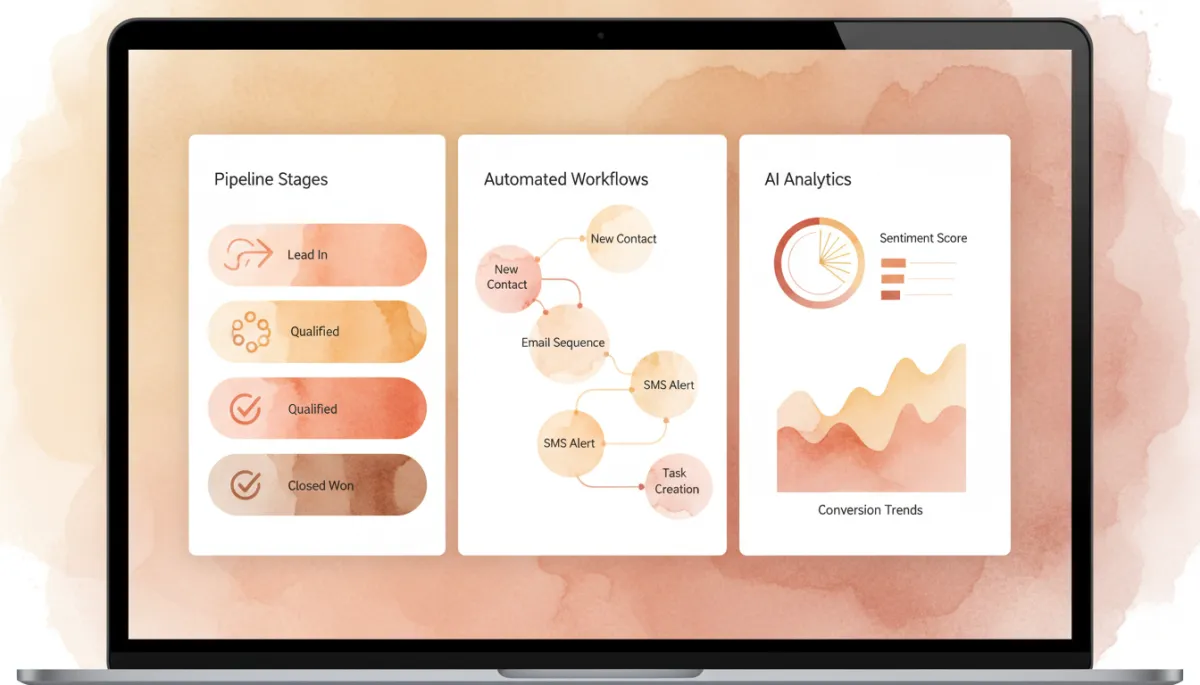
-style dashboard close-up showing GoHighLevel pipeline stages, automated workflows, and AI...
A single pipeline view connects lead capture, nurturing, and sales follow-up in real time.
The GoHighLevel Economics Model™: From Cost Centers to Revenue Assets
The GoHighLevel Economics Model™ explains why agencies that adopt HROS™ outgrow those that just “run campaigns.” It reframes your tech stack and workflows as revenue assets rather than cost centers.
Acquisition Economics: Track
Cost per Lead → Cost per Opportunity → Cost per Customerdirectly from campaigns and pipelines.Workflow Economics: Measure how automation reduces human minutes per stage (e.g., manual follow-up, rescheduling, no-show chasing) and reassigns that time to higher-value work.
Retention Economics: Use memberships, nurture, and review workflows to increase LTV and renewal rates, turning one-time projects into subscription relationships.
SaaS Economics: Layer white-labeled accounts and AI add-ons on top of services to build margin-rich recurring SaaS revenue that isn’t tied to billable hours.
💡 Pro Tip: Before you launch another campaign, define the economic path: “For every $1 into ads and AI usage, we want $X in pipeline and $Y in closed revenue within Z days.”
The Revenue Automation Flywheel™: How Everything Reinforces Growth
The Revenue Automation Flywheel™ is a simple loop that explains how GoHighLevel compounds results when operated as an HROS™:
Leads: Capture leads via funnels, forms, surveys, inbound calls, and AI chat—each tagged to a campaign and source.
Automation: Trigger workflows, AI Employees, and sequences that handle follow-up, qualification, and booking without human lag.
Conversion: Move opportunities through well-defined pipeline stages, supported by calendars, reminders, and sales tasks.
Revenue: Log deals, memberships, and subscriptions back into the CRM, tying revenue to channels and workflows.
Customer Intelligence: Collect reviews, NPS, support tickets, and behavioral signals (opens, clicks, logins, course progress).
Optimization: Use reports, attribution, and AI insights to refine offers, copy, targeting, and workflows—feeding improvements back into lead generation.
📌 Key Takeaway: When the flywheel is built correctly, every new lead makes the system smarter, cheaper, and more effective for the next one.
Key Features, Benefits, and Business Impact
CRM & Pipelines: Unlimited contacts, smart lists, tags, Kanban pipelines, revenue forecasting—linking marketing spend to closed revenue. In an HROS™, pipelines are not “boards”; they are process definitions that encode how your agency sells and delivers.
Marketing Automation: Visual workflows, two-way SMS and email, review requests, nurture sequences, and social posting reduce manual follow-up by 60–80%. These automations become reusable assets that you can clone, tweak, and monetize across clients.
Sales Integration: Calendars, call tracking, Voice AI booking, and opportunity stages give sales teams one place to work and report. This reduces data silos and makes sales behavior visible to marketing and leadership in real time.
Agency & SaaS Mode: White-label, snapshots, and automated billing enable new revenue models—retainers plus recurring SaaS seats. Operationally, this is how you turn your best workflows into productized, machine-readable systems.
💡 Pro Tip: Replace “feature checklists” in your internal planning with “system diagrams”—how does each feature plug into your HROS™ layers and the Revenue Automation Flywheel™?
Operational Architecture and Systems Thinking with GoHighLevel
To unlock GoHighLevel, think like a systems architect, not a tool user. Every element—pipeline, form, tag, workflow—should exist for a reason inside your revenue architecture.
Define canonical objects: lead, MQL, SQL, opportunity, customer. Map which statuses and pipelines represent each stage, and enforce that structure across all accounts and clients.
Treat workflows as micro-services: one workflow for lead capture, one for no-show recovery, one for review requests, etc.—each with a clear input and output, instead of one giant automation trying to do everything.
Use naming conventions for campaigns, tags, and workflows (e.g.,
[Client]-[Funnel]-[Stage]-[Channel]) so humans and AI can understand your system at a glance.
“Agencies that win with GoHighLevel don’t build campaigns; they build systems that campaigns plug into.”
Pros, Cons, and Maturity Models for Agencies
Pros: Tool consolidation, lower total cost than stacking HubSpot + ClickFunnels + Calendly; strong AI roadmap; built for agencies.
Cons: Learning curve, UI inconsistency, and usage-based SMS/AI costs that must be modeled carefully.
A practical maturity model: Stage 1 – replace basic CRM and calendar; Stage 2 – centralize funnels, nurture, and reviews; Stage 3 – roll out AI Employees and SaaS mode; Stage 4 – standardize snapshots and operating procedures across all clients.
HighLevel Maturity Scorecard: How Ready Is Your Agency?
Use this simple maturity scorecard to assess where you are today. Rate each dimension from 1 (ad hoc) to 5 (fully standardized and optimized):
Dimension 1–2: Emerging 3–4: Scaling 5: Operationally Elite Automation Manual follow-up; few workflows; inconsistent triggers. Core journeys automated (lead-to-call, review, no-show). Library of reusable workflows across all clients. Attribution No clear link from campaigns to revenue. Source tracking on main funnels; basic reporting. Multi-touch attribution and channel-level ROI decisions. SaaS Monetization Only service retainers; no productized platform. Some clients on white-labeled accounts; basic packaging. Tiered SaaS plans with AI add-ons and automated billing. AI Adoption Occasional AI copy; no operational AI Employees. AI in key workflows (inbound calls, FAQs, simple tasks). AI Employees embedded across support, sales, and content. Operational Standardization Every client is a one-off build. Shared templates and partial snapshots. Full snapshot library and SOPs for each vertical.
📌 Key Takeaway: Your HROS™ is only as strong as your weakest dimension. Use the scorecard to prioritize improvements.
Ownership Framework: Who Runs Your Revenue Operating System?
Many agencies treat GoHighLevel as “everyone’s job,” which quickly becomes “no one’s job.” A simple ownership framework keeps your HROS™ healthy:
CRM Management: One owner defines fields, tags, pipelines, and naming conventions—and reviews them monthly to avoid sprawl and duplicate entities.
Automation Governance: A designated builder approves new workflows, manages versions, and ensures every automation has a documented purpose and test plan.
Reporting & Attribution: Someone owns dashboards, attribution models, and weekly reporting cadences so decisions aren’t based on conflicting numbers.
AI Oversight: An AI lead defines prompts, training data, guardrails, and review processes for AI Employees, ensuring outputs stay on-brand and compliant.
⚠️ Warning: Powerful systems without clear ownership create silent failure—leads fall through cracks, AI acts on stale data, and no one notices until revenue dips.
Common Mistakes, Best Practices, and Real-World Use Cases
Common mistakes: Turning on every feature at once, ignoring attribution setup, and underestimating SMS/AI usage costs.
Best practices: Start with one high-value workflow (e.g., lead-to-booked-call), document your pipeline stages, then clone via snapshots.
Industry examples include local service businesses automating review requests across 52 platforms, coaching brands launching memberships without extra tools, and agencies adding $10k+ MRR by bundling managed campaigns with white-labeled accounts.
Why Many Agencies Still Fail with Powerful Platforms
The contrarian truth: access to software does not create a system. Many agencies churn through tools like GoHighLevel, HubSpot, or Salesforce and still struggle because:
They buy platforms to avoid process work instead of to encode their process.
They let every account manager build their own pipelines and automations, creating chaos the moment someone leaves.
They never wire attribution correctly, so leadership loses trust in the numbers and reverts to gut decisions.
They treat AI as a toy for copywriting instead of a serious operational layer requiring governance and training data.
The agencies that win are not “better at GoHighLevel”—they are better at designing and owning a Revenue Operating System.
AI, GEO, and the Future of Machine-Readable Business Systems
GoHighLevel’s 2026 roadmap leans into AI Employees, natural-language workflow building, and AI-generated funnels, blogs, and courses. Expect deeper revenue attribution, predictive forecasting, and more vertical-specific templates (gohighlevel.ai).
In parallel, AI search and GEO (Generative Engine Optimization) are shifting how prospects discover and evaluate businesses. GoHighLevel can become your machine-readable business system if you design it that way:
AI Discoverability: Consistent offers, pricing, and messaging across funnels, blogs, and automations help AI engines understand who you serve and what you deliver—improving inclusion in AI-generated answers.
Entity Consistency: Use the same business names, locations, services, and schemas across your GoHighLevel sites, Google profiles, and directories so AI models can confidently link all references to the same entity.
AI Trust Signals: Automate collection of reviews, testimonials, case studies, and educational content. These become signals that LLMs can cite when recommending vendors in conversational search.
💡 Pro Tip: Treat every GoHighLevel funnel and asset as both a human-facing experience and an AI-facing data source that should be structured, consistent, and trustworthy.
AI, Future Trends, and Expert Recommendations
GoHighLevel’s 2026 roadmap leans into AI Employees, natural-language workflow building, and AI-generated funnels, blogs, and courses. Expect deeper revenue attribution, predictive forecasting, and more vertical-specific templates (gohighlevel.ai).
💡 Expert recommendation: Treat GoHighLevel as your core operating system, not “just another tool.” Assign an internal owner, document your workflows, and review pipeline and attribution reports weekly.
If you’re consolidating tools or exploring SaaS revenue, start with the 30-day trial, implement one flagship use case, and then decide whether to scale to Unlimited or SaaS Pro.
Final Verdict
For agencies and growth-minded service businesses, GoHighLevel is one of the few platforms that genuinely unifies CRM, marketing, and sales into a measurable revenue system. It is not the simplest option—but for teams willing to invest in process, it delivers outsized operational leverage and new recurring revenue streams.
Ultimately, the value of GoHighLevel lies in its ability to power a HighLevel Revenue Operating System™—not in any single feature. When you design clear architectures, own your data and automations, and plug into the GoHighLevel Economics Model™ and Revenue Automation Flywheel™, the platform becomes a durable competitive advantage rather than “just another CRM.”
FAQs: GoHighLevel, CRM Platform, and Revenue Operations
1. What is GoHighLevel in simple terms?
It’s an all-in-one CRM and marketing automation platform that runs your leads, campaigns, and sales pipelines from one place.
2. How does GoHighLevel combine CRM, marketing, and sales?
Contacts, messages, funnels, and deals live in one database, connected by visual workflows that automate follow-up and reporting.
3. Who is GoHighLevel best suited for?
Marketing agencies, consultants, and service businesses that rely on lead generation and booked appointments.
4. What are the main pricing plans?
Starter ($97), Unlimited ($297), and SaaS Pro ($497) per month, plus usage-based messaging and AI fees.
5. Does GoHighLevel replace tools like ClickFunnels and Mailchimp?
In many cases yes—it includes funnels, websites, email, SMS, and CRM in one platform.
6. How steep is the learning curve?
Expect 30–60 days to become comfortable and longer to master advanced AI and SaaS features.
7. What are GoHighLevel snapshots?
Prebuilt configurations of funnels, workflows, and settings you can deploy to new client accounts in minutes.
8. Can I white-label GoHighLevel?
Yes, Unlimited and SaaS Pro allow full white-labeling with your own domain, logo, and pricing.
9. How does AI improve performance in GoHighLevel?
AI Employees handle calls, chats, content, and workflows, increasing speed and reducing manual labor in campaigns.
10. What operational frameworks work best with GoHighLevel?
Map your customer journey, define pipeline stages, then build one workflow per stage to enforce consistency.
11. Which industries see the most value?
Local services, home improvement, medical, legal, coaching, and multi-location franchises see strong ROI.
12. How do agencies monetize GoHighLevel?
Through retainers, performance fees, and SaaS subscriptions for white-labeled accounts and AI add-ons.
13. What are the biggest risks?
Poor implementation, lack of ownership, and ignoring data hygiene can limit results despite strong features.
14. Is GoHighLevel suitable for in-house marketing teams?
Yes, especially for mid-sized teams that want integrated lead generation, nurture, and sales reporting.
15. How should we start with GoHighLevel?
Begin with one core funnel and follow-up workflow, measure booked calls and revenue, then scale to more journeys.


