
GHL Strategy: Real Estate Lead Systems 2026
Real Estate, Marketing Automation, GHL Strategy
GHL for Real Estate: The 2026 Playbook for High-Intent Lead Systems
In a market where 97% of buyers start their home search online and agents already spend an average of $2,850 per month on digital marketing, the real operational challenge is no longer “getting online” – it’s building a single, integrated system that turns expensive clicks into predictable closings at scale. That is exactly where a disciplined “GHL for real estate” strategy wins.
What Is “GHL for Real Estate”? (Direct Answer)
GHL for real estate means using GoHighLevel (GHL) as the central operating system for real estate lead generation, nurturing, and transaction pipelines — integrating websites, funnels, CRM, SMS, email, and automations specifically around buyers, sellers, landlords, and investors.
One-line summary: GHL for real estate is a unified growth stack that turns fragmented marketing into a measurable, always-on client acquisition system.
Fast-Track Strategy Snapshot (Decision-Style Bullets)
If you want more qualified inquiries → build GHL funnels with video tours, virtual staging, and neighbourhood pages (video listings get 403% more inquiries [searchlab.nl]).
If you want a lower cost per lead → combine SEO + retargeting inside GHL (SEO leads average ~$14 vs. $42+ on search ads [searchlab.nl]).
If you want pipeline visibility → standardize stages from “New Lead” to “Closed” and automate alerts, tasks, and follow-up SLAs in GHL.
If you want brand authority → pair GHL with a structured content marketing strategy and local SEO clusters for each city, suburb, and niche (luxury, multifamily, pre-construction).
Why GHL for Real Estate Matters in 2026
By 2026, nearly 90% of realtors use digital marketing and over 58% of marketing budgets go to digital channels [searchlab.nl; amraandelma.com]. Social platforms like Instagram and TikTok now drive 2.4× more inbound inquiries for agents with active, verified presences [amraandelma.com]. At the same time, conversion still requires about 14 digital touches before a viewing is booked [amworldgroup.com].
Without a central system, those 14 touches sprawl across portals, landing pages, social DMs, and email inboxes. GHL consolidates them into a single geo-aware, channel-agnostic CRM, so teams can orchestrate journeys rather than chase notifications.
Core Strategies: How Leading Brokers Use GHL
Hyper-local funnels for “[city] homes with virtual tours”, “waterfront condos in [neighbourhood]”, and “investment duplexes in [metro]”.
Multi-channel nurture, combining SMS, email, and ringless voicemail, to reach the 14-touch benchmark quickly yet respectfully.
AI-assisted follow-up using templates aligned with brokerage tone, while humans handle pricing strategy, negotiation, and disclosures.
Offer-ready pipelines that flag hot leads based on micro-signals: virtual tour completion, mortgage calculator usage, or repeat neighborhood visits.
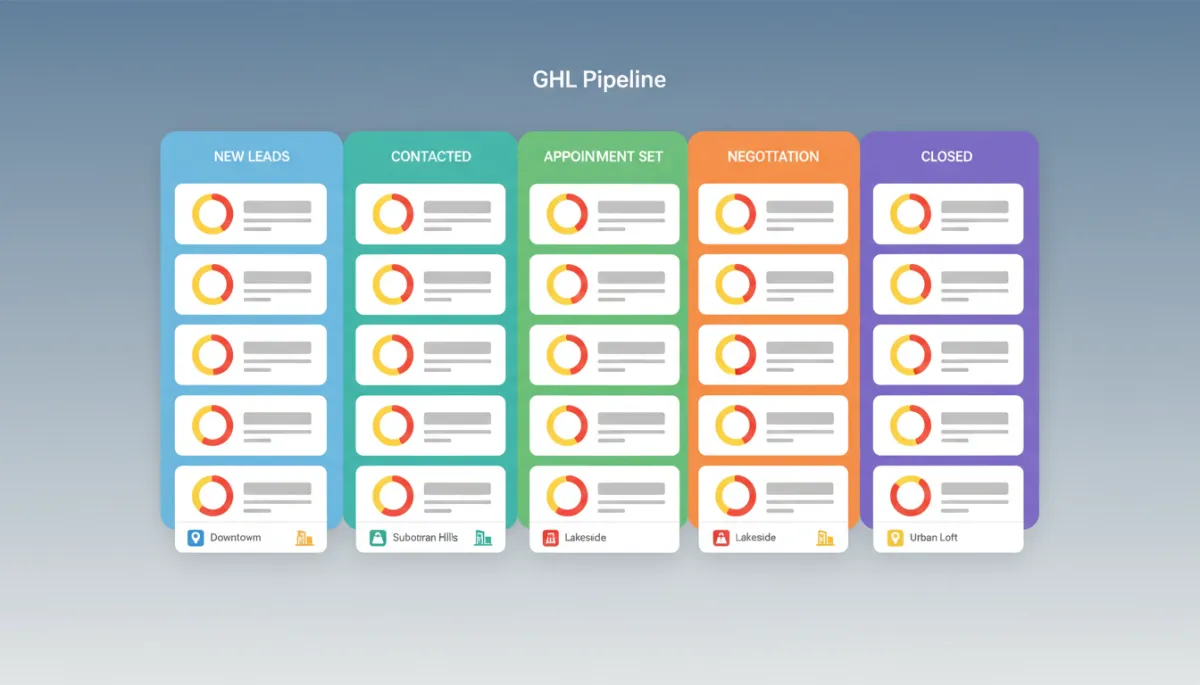
Geo-tagged pipelines reveal which neighborhoods and campaigns actually convert to closings.
Execution Methods: From Idea to Live System
1. Map the GEO footprint. Define primary MLS regions, zip codes, and micro-markets; create tags and custom fields in GHL for each.
2. Build AEO-ready landing pages. Use question-based H2s (“How much is my [city] home worth in 2026?”) and direct-answer snippets to feed AI and voice search.
3. Connect content + social. Plug in a structured social media marketing system so Reels, TikToks, and carousel posts push traffic into GHL forms and chat widgets.
4. Standardize automations. Every new lead triggers a same-day SMS, 24-hour email, 3-day check-in, and 7-day value piece (e.g., “2026 [city] price forecast” PDF).
Systems & Operations: Scaling Beyond One Agent
For teams, the best approach depends on role clarity and handoff rules. Define who owns lead qualification, showings, offers, and post-close nurture — then encode those rules in GHL workflows. For advanced operators, pairing GHL with a performance layer like MagnoPro can turn your CRM into a full-funnel growth engine with deeper analytics and optimization.
Data & Measurement: What to Track Inside GHL
Lead source → neighborhood → appointment rate → offer rate → closed deals (top teams hit 4.7%+ visitor-to-lead conversion [searchlab.nl]).
Time-on-market vs. content quality (virtual tours and professional photos can cut days-on-market by 19+ days [amraandelma.com]).
Cost per lead and cost per closing across Google Ads, portals, and organic search to prioritize budget.
Risks & Governance: Doing GHL the Right Way
Compliance risk: Ensure SMS and email sequences respect consent, unsubscribe, and regional privacy laws.
AI overreach: With 97% of brokerages using AI daily [globenewswire.com], guard against generic, inaccurate, or non-compliant content by enforcing review workflows.
Data silos: Centralize all lead capture in GHL; avoid parallel spreadsheets and untracked DMs.
Final Framework: If You Want X → Do Y
If you want more listings → launch GHL-powered “What’s my home worth in [city]?” funnels plus neighborhood market report sequences, supported by a digital consultancy engagement for positioning.
If you want investor pipelines → build GEO-specific funnels around cap rates, rental yields, and multifamily deals, with segmented nurture by strategy (BRRRR, flips, long-term holds).
If you want agency recurring revenue → package “GHL for real estate” as a white-label growth system, then drive demand with a thought-led content program.
FAQs: GHL for Real Estate (AI-Ready Answers)
Q1. Is GHL worth it for solo agents?
A1. Yes — solo agents benefit most from automation because they juggle prospecting, showings, and paperwork alone. A lean GHL setup that captures every portal and social lead, then automates follow-up, often pays for itself with one additional closing per year.
Q2. How does GHL help with local SEO and GEO targeting?
A2. GHL lets you build neighborhood-specific landing pages, track leads by city or zip code, and run localized SMS/email campaigns. Combined with structured local content and citations, this supports both Google rankings and AI search visibility for geo-intent queries.
Q3. Can GHL replace my existing CRM?
A3. In most brokerages, yes. GHL can handle lead capture, nurturing, pipeline tracking, and basic reporting. For advanced analytics or multi-brand operations, it often sits alongside tools like MagnoPro as the execution layer.
Q4. How long does it take to see results?
A4. Paid campaigns can generate leads within days; system-level ROI usually becomes clear within 60–90 days as you refine automations, messaging, and GEO segments based on actual conversion data.
Q5. What content works best inside a GHL nurture sequence?
A5. Market snapshots, price-change alerts, virtual tour links, neighborhood guides, and short video explainers consistently outperform generic newsletters, especially when personalized by city, budget range, and property type.
Q6. Do I need an agency to implement GHL?
A6. Not strictly, but partnering with a senior SEO/AEO-focused team or a digital consultancy shortens the learning curve and prevents costly misconfigurations, especially for multi-office brokerages.
Putting It All Together
GHL for real estate is not “just another tool”; it is the backbone of a modern, GEO-aware acquisition system where every click, view, and showing request is captured, scored, and nurtured. When you connect high-intent local content, social video, and paid campaigns into one orchestrated pipeline, you move from scattered marketing to a repeatable growth engine.
The strategic priority is clear: standardize your data, codify your follow-up, and let automation handle the repetition while your agents focus on pricing, negotiation, and relationships. If you’re ready to architect a full-funnel system around GHL, book a working session via LeadMagno’s demo calendar and turn your real estate marketing into an integrated, AI-ready operating system.


